
Uranus's Tiny Moons: Dark, Red, and Water-Deprived
The Red, Dark, and Water-Poor Moons of Uranus
Uranus, often referred to as the solar system's oddball planet, has moons that are just as peculiar. Recent infrared spectra of Uranus’s small inner moons, set to be presented at the 2025 AGU Annual Meeting in New Orleans, reveal that their surfaces are significantly redder, darker, and more water-poor compared to the larger moons farther from the planet.
Matt Hedman, a planetary scientist at the University of Idaho and coauthor on the research, explained that the team aimed to understand how these properties vary across the rings and moons. "We didn't have much information about their spectra before because they're hard to observe," he said.
The new findings also indicate that some moons aren’t where they should be, underscoring how much remains unknown about the dynamics of the Uranian system.
Small, Dark, and Red
In 1986, Voyager 2 made humanity’s only visit to Uranus, discovering 11 new moons and providing rough measurements of their sizes. Since then, scientists have used ground- and space-based telescopes to identify over a dozen additional satellites, bringing the total number of Uranus’s moons to 29.
Many of these newly discovered moons are tiny, ranging from Sycorax at 150 kilometers across to Mab and Cupid at just 10 kilometers. Most orbit within or just outside Uranus’s ring system, close to the bright planet.
These characteristics have made it challenging for astronomers to study the smallest Uranian moons. Enter the James Webb Space Telescope (JWST), an infrared powerhouse that has enabled deeper observations.
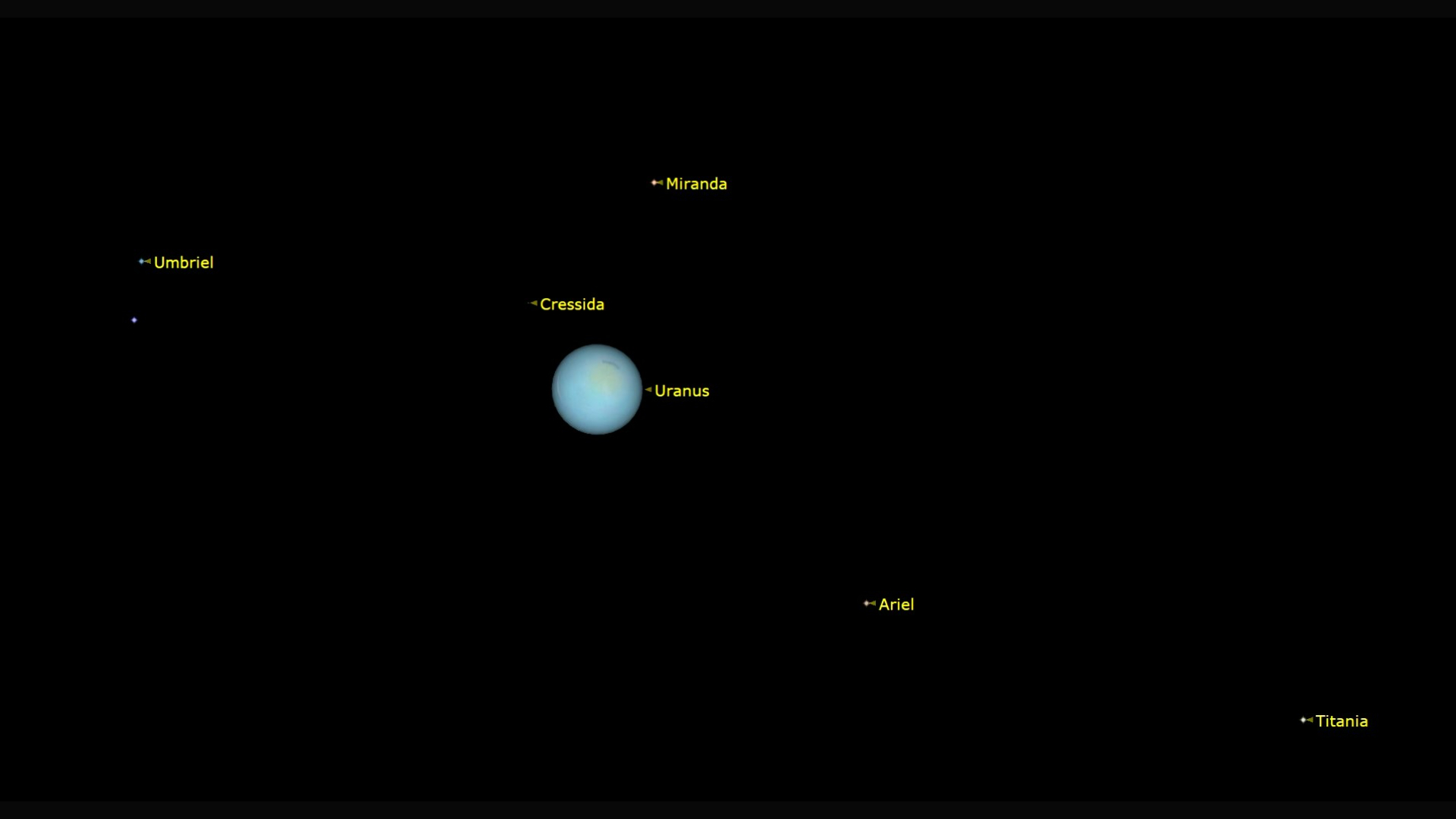
"The JWST is particularly good for this compared to optical telescopes like Hubble because Uranus is much fainter in the infrared, making it easier to see the moons orbiting it," Hedman explained. Additionally, the telescope can detect spectral features like water ice, which are key to understanding the moons’ compositions.
The researchers observed Uranus at several infrared wavelengths in February, gaining a detailed view of the inner parts of the planetary system. They aimed to characterize known small moons and search for new ones. They did discover a previously unknown moon, temporarily named S/2025 U1, orbiting just outside the epsilon ring.
These observations provided the first infrared brightness data for many of the smallest moons, some of which had remained elusive since the Voyager flyby.
"Most of the rings and inner moons show similar properties—they tend to be much redder, darker, and more water-poor compared to the larger outer moons like Miranda, Ariel, Umbriel, Titania, and Oberon," Hedman said.
"And then there's Mab," he added.
A Unique Moon: Mab
The new spectra show that Mab’s surface is bluer and more water-rich than other inner moons, according to Jacob Herman, a physics graduate student at the University of Idaho and lead author on the research. Mab’s surface spectrum resembles that of Miranda, the major moon that orbits closest to the rings and to Mab.
Miranda’s jigsaw-like surface suggests a chaotic history. Could Mab and Miranda have encountered each other during Uranus’s turbulent past? Could this interaction relate to Uranus’s mu ring, which may be generated by material sloughing off Mab?
Hedman hopes future observations or a long-term mission to Uranus will provide answers.
"These new measurements expand our knowledge, revealing striking variations in the composition and reflectivity of moons such as Mab, Cupid, and Perdita," said Jadilene Xavier, an astrophysicist at São Paulo State University in Brazil, who was not involved in the research.
"There is still much to learn about Uranus’s small inner moons, especially regarding their origin, composition, and orbital stability," Xavier added. More precise data on their density, shape, and surface properties would help determine if these moons are fragments from collisions, captured objects, or remnants from the formation of Uranus’s ring system.
Off Course
Because Voyager 2 spent only a short time near Uranus, it could only provide limited data on the small moons’ orbital periods and distances, with large uncertainties. When the researchers compared current positions with predictions based on Voyager 2 data, some moons were not where they should be.
"Perdita was quite a bit off," Herman said. "Cupid was also surprising." The positions of Cordelia, Ophelia, Cressida, and Desdemona were slightly off as well, but not by much. The team is still investigating whether the differences stem from more precise observations or unknown dynamics.
"These observations help improve our understanding of the inner Uranian system, especially its orbital dynamics," said Matija Ćuk, a researcher at the SETI Institute in Mountain View, Calif., who was not involved in the study.
Ćuk noted that Cordelia and Ophelia shepherd Uranus’s epsilon ring, while Cressida and Desdemona are part of a group with chaotic orbits. Perdita interacts with another moon, Belinda. "So the fact that these moons are not in their predicted positions is valuable for understanding the system, but I wouldn’t say it’s unexpected."
These observations hint at the many mysteries Uranus still holds.
"For a dynamicist like me," Ćuk said, "knowing the precise masses of these moons would be ideal, as it would allow us to predict their future interactions and estimate their long-term stability."
Hedman and his team plan to observe the Uranian system again with JWST, analyze archived images, and establish long-term monitoring to better understand the moons’ dynamics and potentially estimate their masses. They are also working with colleagues who simulate planetary orbits to explore how Uranus’s moons and rings might influence each other.
"It's a very dynamic and interconnected system," Herman said.

Posting Komentar untuk "Uranus's Tiny Moons: Dark, Red, and Water-Deprived"
Posting Komentar