
Watching Ultrafast Magnetic Changes at the Nanoscale with Soft X-Rays

Scientists at the Max Born Institute have made a groundbreaking advancement in the field of magnetism research with the development of a new soft X-ray instrument. This innovative tool is capable of revealing the dynamics of magnetic domains on nanometer-length and picosecond-time scales. By bringing capabilities that were once exclusive to X-ray free-electron lasers (XFELs) into the laboratory, this work opens the door for more routine investigations of ultrafast processes involving emergent textures in magnetic materials and beyond.
A dropped fridge magnet offers a simple yet insightful glimpse into a complex physical phenomenon. Although it may appear undamaged on the surface, its holding force can weaken due to changes in its internal magnetic structure. These changes occur as the magnet reorganizes into countless tiny regions with opposing magnetization, known as magnetic domains.
These nanoscale textures are central to modern magnetism research, but observing them at very short time scales has traditionally required access to large-scale XFEL facilities. The development of a laboratory-scale instrument now advances this research significantly.
Laboratory-scale instrument advances research
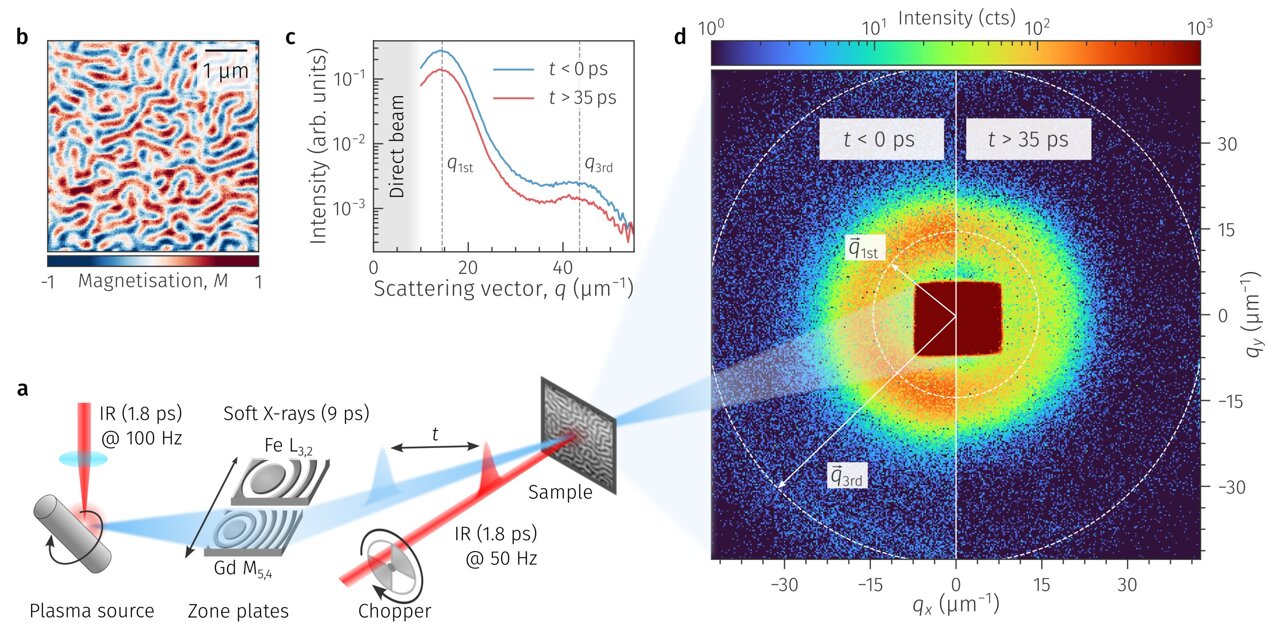
Researchers at the Max Born Institute (MBI) have developed a laboratory-scale soft X-ray instrument capable of "seeing" these hidden structures with nanometer (10^-9 m) spatial and picosecond (10^-12 s) temporal resolution. Their work, published in Light: Science & Applications, shows that the ultrafast dynamics of magnetic domains can be tracked in great detail directly in the lab.
Soft X-rays combine exceptional sensitivity to magnetic order with element specificity and high spatial resolution. In a small-angle X-ray scattering (SAXS) geometry, real-space magnetic domain patterns are translated into intensity distributions in reciprocal space, providing rich information about the long- and short-range order of complex magnetic textures.
Until now, ultrafast resonant SAXS in the soft X-ray regime was available only at XFELs. The new MBI setup overcomes this limitation by pairing a laser-driven plasma X-ray source with a dedicated single-photon–sensitive area detector. Operating at 100 Hz with 9-ps temporal resolution, the instrument achieves the stability and sensitivity needed to capture extremely weak diffuse scattering signals.
To demonstrate its capabilities, the team studied a ferrimagnetic Fe/Gd multilayer hosting nanoscale magnetic maze domains.
New insights into magnetic domain dynamics
By tuning the soft X-rays to absorption edges of Fe and Gd around 700 and 1200 eV, respectively, they mapped element-specific magnetization dynamics and discovered a previously unobserved, complex reorganization of the domain pattern on picosecond to nanosecond timescales—likely driven by inhomogeneity of the optical excitation within the sample.
"This instrument lets us observe magnetic order with a level of detail that previously required a free-electron laser," says Leonid Lunin, one of the study's first authors. "Now we can do it every day, directly in the laboratory."
Thanks to its flexibility and photon efficiency, the platform enables systematic studies involving variations in magnetic field, temperature, excitation fluence, or photon energy—measurements that are currently difficult or impossible at most large-scale facilities.
Looking ahead, the authors anticipate further increases in photon flux and sensitivity using next-generation laser and detector technology. Such upgrades could make multidimensional scans and advanced excitation schemes routine, opening new avenues for studying emergent phases in a broad range of complex materials.

Posting Komentar untuk "Watching Ultrafast Magnetic Changes at the Nanoscale with Soft X-Rays"
Posting Komentar