
What's Happening with 3I/ATLAS? NASA Photo Shows Comet Approaching Earth
NASA's Hubble Space Telescope Captures 3I/ATLAS Again
NASA's Hubble Space Telescope has once again captured images of the interstellar comet 3I/ATLAS. This unique object, which is on a trajectory that will bring it close to Earth in December, has been under the watchful eye of Hubble. The iconic observatory, launched into orbit in 1990, first spotted 3I/ATLAS in July shortly after its discovery within Earth's solar system. It originated from another part of the Milky Way galaxy.
For months, 3I/ATLAS has drawn significant attention and even sparked some unusual theories about alien spacecraft. As it makes its way through our cosmic neighborhood, it will eventually leave our solar system forever.
What is 3I/ATLAS?
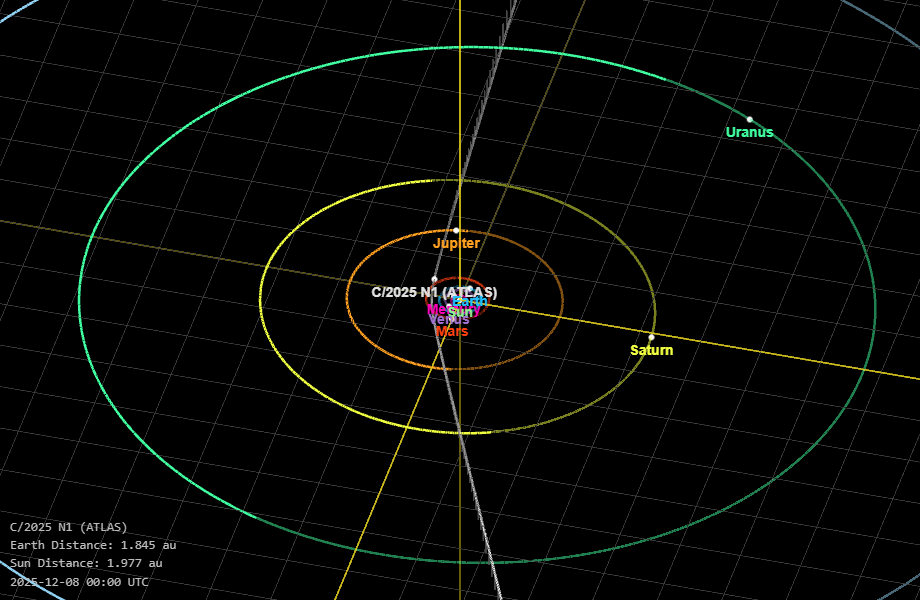
An object known as 3I/ATLAS made headlines in July 2025 when it was confirmed to be the third-ever object discovered originating outside Earth's solar system. When it was first observed, 3I/ATLAS was moving at approximately 137,000 miles per hour, according to NASA. Observations of its speed and trajectory confirmed to astronomers that it formed in another star system and was ejected into interstellar space. For potentially billions of years, the comet has been drifting from the general direction of the constellation Sagittarius in the center of the Milky Way, recently entering our solar system.
Unlike comets bound by the sun's gravity, 3I/ATLAS follows a hyperbolic orbit that will eventually take it out of the solar system and back into interstellar space.
Hubble's Second Look at 3I/ATLAS
The Hubble Space Telescope is one of many NASA instruments that have focused on 3I/ATLAS as it travels through our solar system. Hubble's latest sighting of the interstellar object occurred on November 30, according to a December blog post.
At that time, 3I/ATLAS was about 178 million miles from Earth. Because Hubble was tracking the comet as it moved across the sky, stars in the background appear as streaks of light in the image.
Hubble's initial observations helped determine the size of 3I/ATLAS. While astronomers don't yet know exactly how big it could be, estimates range from a few hundred feet to a few miles across. Hubble's data also helped estimate the size of the comet’s solid, icy nucleus as anywhere from about 1,400 feet to 3.5 miles wide.
ESA's Jupiter Orbiter Also Observes 3I/ATLAS
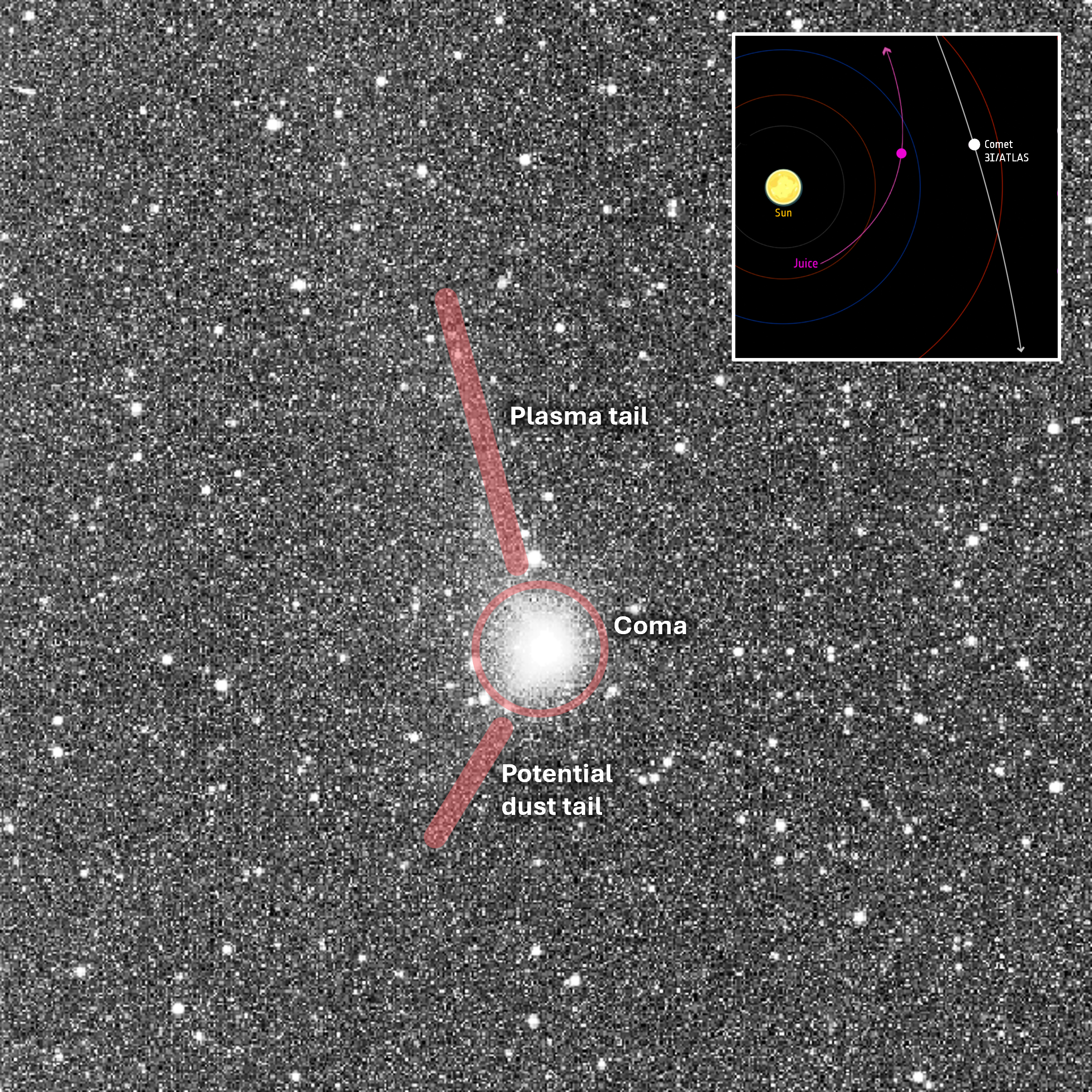
A European Space Agency orbiter heading toward Jupiter recently observed 3I/ATLAS. The ESA's Jupiter Icy Moons Explorer (Juice) spotted the comet between November 2 and November 25 when it was in an "active state" following its closest approach to the sun on October 30. Due to the spacecraft being far from Earth on the other side of the sun, scientists do not expect to receive its observations until February.
However, the mission team managed to download a quarter of a single image from JUICE's navigation camera as it travels to Jupiter by 2031. The image was taken on November 2, two days before JUICE's closest approach to the comet on November 4 at a distance of about 41 million miles. Signs of activity are clear in the image, including the comet's glowing halo of gas, known as its coma, and two distinct tails.
NASA Releases New Photos of 3I/ATLAS
NASA released a collection of never-before-seen images of 3I/ATLAS on November 19, revealing new details about the object. A look at all the photos NASA has released since its July discovery, including detailed explanations of each, is available below.
Where is 3I/ATLAS Now? Will It Be Visible from Earth?
The comet 3I/ATLAS, which poses no threat to Earth, is expected to pass within about 170 million miles of our planet on December 19—roughly twice the distance between Earth and the sun. Although 3I/ATLAS is not visible to the naked eye, those with even a small telescope can observe it in the pre-dawn sky until spring 2026. NASA's "Eyes on the Solar System" online simulation shows the location and path of 3I/ATLAS as it moves through our solar system.
Is 3I/ATLAS an Alien Spaceship? NASA Dismisses Conspiracy Theory
The strange comet's journey through Earth's cosmic neighborhood has led to various outlandish conspiracy theories about its nature. One notable idea, proposed by Harvard astrophysicist Avi Loeb, suggests that 3I/ATLAS could be an alien spaceship. Although Loeb has acknowledged that the object is "most likely a comet of natural origin," he has not ruled out the possibility that it could be extraterrestrial technology.
NASA officials have attempted to address these theories. In a social media exchange with reality TV star Kim Kardashian in October, NASA Acting Administrator Sean Duffy stated, "No aliens. No threat to life here on Earth." Nicola Fox, associate administrator of NASA's Science Mission Directorate, also rejected the alien theory during a news conference, stating, "We certainly haven't seen any technosignatures or anything from it that would lead us to believe it was anything other than a comet."

Posting Komentar untuk "What's Happening with 3I/ATLAS? NASA Photo Shows Comet Approaching Earth"
Posting Komentar