
Haptic Display Tech Lets You See and Feel 3D Graphics
A New Era of Visual-Haptic Displays
Researchers at UC Santa Barbara have developed a groundbreaking display technology that combines visual and tactile feedback. This innovation allows on-screen graphics to be both seen and felt, opening up new possibilities for user interaction with digital content.
The screens are designed with tiny pixels that expand outward when illuminated, creating bumps that can be felt by touch. This feature enables the display of dynamic graphical animations that engage both sight and touch. The potential applications of this technology are vast, ranging from high-definition visual-haptic touchscreens in automobiles, mobile computing devices, to intelligent architectural walls.
Max Linnander, a Ph.D. candidate in the RE Touch Lab under the supervision of mechanical engineering professor Yon Visell, led the research that was published in the journal Science Robotics.
Visell presented a challenge to Linnander when he joined UCSB in late September 2021. "The question was simple: Could the light that forms an image be converted into something that can be felt?" Linnander recalled.
"We didn't know if it was feasible," added Visell. "The possibility that it might be impossible—and the very idea of enabling people to 'feel light'—made the question irresistible."
The team spent nearly a year testing their idea, working through theoretical concepts and conducting computer simulations. After developing a viable concept, they began building prototypes in the laboratory. However, progress was slow.
Then, in December 2022, Linnander invited Visell into the lab. "I had been working on this for a year. I was going to leave for the airport in a few hours, and I had just gotten my latest prototype up and running," he said.
He showed Visell a simple, functional prototype—a single pixel excited by brief light flashes from a small diode laser, with no other electronics.
"I put my finger on the pixel and felt a clear tactile pulse whenever the light flashed," Visell recalled. "That was a special moment—the moment we knew the core idea could work."
At the heart of the technology are thin display surfaces that integrate arrays of millimeter-sized optotactile pixels. These pixels are individually controlled by projected light from a low-power laser, a form of optical addressing.
The same light source powers the pixels, which contain an air-filled cavity and a suspended thin graphite film. The film absorbs incoming light and rapidly rises in temperature, which heats the captive air. The air expands, and the pixel's top surface deflects outward by as much as one millimeter—yielding an easily perceptible bump above the illuminated pixel.
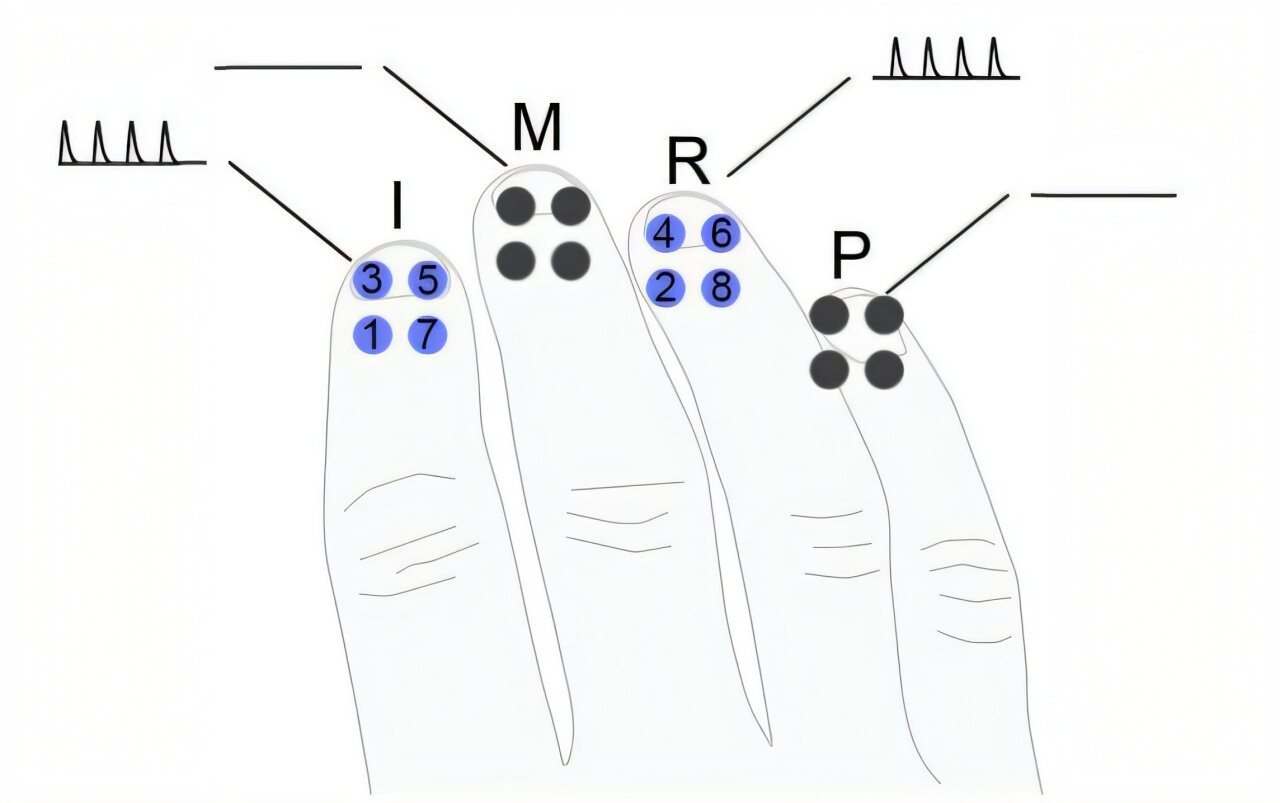
The process is so fast that scanning a light beam across many pixels in succession yields dynamic graphics—contours, moving shapes, characters—that can be both seen and felt. The refresh rate is fast enough to enable animations to look and feel continuous, similar to familiar video displays.
Because light provides both illumination and power delivery, the display surfaces require no embedded wiring or electronics. Instead, a small scanning laser sweeps the surface at high speed, illuminating each pixel for a fraction of a second.
The technology is also scalable: the team has demonstrated devices with more than 1,500 independently addressable pixels—significantly more than comparable tactile displays reported to date, Linnander said. Far larger formats are possible, he added, including displays that leverage modern laser video projectors.
The researchers also studied what users perceived when interacting with the displays. Using touch, participants in their study were able to accurately report the location of individually illuminated pixels with millimeter precision, could accurately perceive moving graphics, and were easily able to discriminate spatial and temporal patterns.
The researchers emphasize that these findings indicate the system is able to produce a wide variety of tactile content.
While the team's findings stand out among prior display technologies, Visell noted that the idea of turning light into mechanical action has noteworthy antecedents.
In the 19th century, Alexander Graham Bell and others used focused sunlight, modulated by the blades of a rotating fan, to excite sound in air-filled test tubes. The same physical principles underlying the optotactile pixels have now been applied to a digital display technology.
These visual-tactile displays could find uses across many domains. Visell envisions that the technology could be used to create automotive touchscreens that emulate physical controls, electronic books with tangible illustrations that come to life on the page, and architectural surfaces for mixed reality, bridging the digital and physical worlds.
Whatever the future may hold, the technology his team has invented embodies a simple, intriguing idea: anything you see, you can also feel.

Posting Komentar untuk "Haptic Display Tech Lets You See and Feel 3D Graphics"
Posting Komentar