
Stunning Close-Up of Ancient Interstellar Comet 3I/ATLAS
A Cosmic Time Capsule: The Mystery of Comet 3I/ATLAS
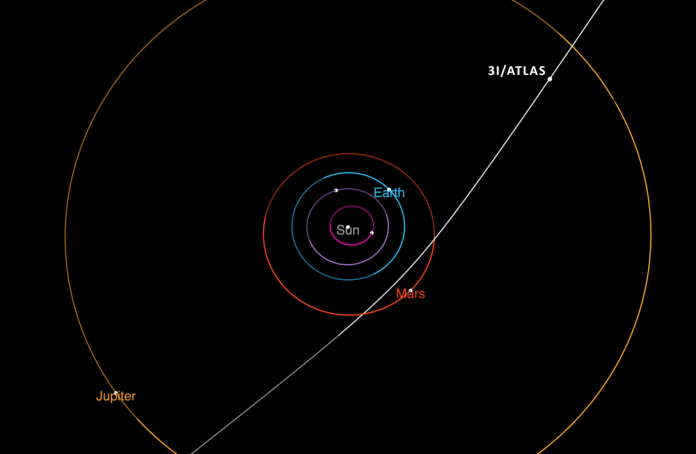
Comet 3I/ATLAS, the third known confirmed interstellar object to enter our solar system, is offering scientists a rare opportunity to study matter that predates the Sun itself. Discovered on July 1, 2025, by the ATLAS survey, this massive comet, approximately 11 kilometers wide, is traveling at over 130,000 mph (210,000 km/h) and is likely more than 7 billion years old. This makes it at least 3 billion years older than our solar system.
NASA’s Mars Reconnaissance Orbiter, equipped with the HiRISE camera, has captured what are expected to be the most detailed images of 3I/ATLAS to date. The orbiter flew within 30 million kilometers of Mars in early October, providing observations with spatial resolution up to three times sharper than those from the Hubble Space Telescope. While HiRISE was designed for mapping Mars, its ability to track a fast-moving target millions of kilometers away demonstrates the versatility of orbital imaging systems in cometary and planetary science. “The HiRISE image would give us a side-view as well as a spatial resolution that is three times better than that of the Hubble Space Telescope,” explained Avi Loeb, an astrophysicist at Harvard. Although the solid nucleus itself remains unresolved, brightness data could tightly constrain its diameter.
Unusual Chemistry and Cosmic Ray Exposure
The comet’s anomalous chemistry has already sparked significant interest. Observations using the James Webb Space Telescope (JWST) and NASA’s SPHEREx mission revealed an extreme CO₂/H₂O ratio of 7.6 ± 0.3, placing it 4.5σ above trends seen in solar system comets. This high CO content and red spectral slope suggest long-term galactic cosmic ray processing of its outer layers. Laboratory experiments show that GCR irradiation efficiently transforms CO into CO₂ while forming organic-rich crusts, modifying the first 15–20 meters of a comet’s surface over gigayear timescales. This implies that current outgassing only samples the irradiated zone, not the pristine interior. As a result, interstellar comets may be seen as depositories of cosmic ray exposure rather than pristine messengers from their native environments.
Tracing the Origins of 3I/ATLAS
Accurate kinematic tracing is essential for determining the origin of 3I/ATLAS. Using the European Space Agency’s Gaia DR3 astrometry, scientists traced its orbit backward over 10 million years and identified 93 stellar encounters, 62 of which were high-confidence interactions with main sequence stars. The strongest encounter occurred with HD 187760 around 72,000 years ago, and it caused negligible changes in velocity. This suggests that the comet has not experienced any significant perturbations during the past 4.27 million years. Its steep trajectory and high velocity point toward a source within the thick disk of the Milky Way, a region populated by ancient stars that aligns with its extraordinary age.
Confirming a Natural Cometary Nature
Spectroscopy has also confirmed the natural cometary nature of 3I/ATLAS. Familiar volatile molecules have been detected, such as those observed by the Very Large Telescope. Additionally, South Africa’s MeerKAT radio array detected hydroxyl radical absorption at 1665 and 1667 MHz, a standard signature of cometary activity near the Sun. The comet is currently active, with a coma and tail, including an “anti-tail” pointing toward the Sun, which results from the sublimation of water, carbon dioxide, and other ices due to solar heating. The scientific significance of studying this object is immense.
Insights into Galactic Evolution
Studying the irradiated crust of 3I/ATLAS could provide insights into how cosmic rays shape icy bodies over billions of years, offering crucial understanding of the chemical evolution of planetary systems across the galaxy. Furthermore, its trajectory and composition may help astronomers refine models of comet formation in ancient stellar environments, potentially distinguishing between origins in primordial planetesimal disks or exo-Oort clouds.
A Deep-Time Emissary
3I/ATLAS will come closest to Earth on December 19 but will remain visible to NASA’s Juno, ESA’s JUICE, and ground-based observatories well into next year. This comet is more than just a fleeting spectacle; it is a deep-time emissary carrying scars from its journey through interstellar space. The upcoming HiRISE images will be crucial for constraining its physical structure, validating compositional models, and advancing our understanding of how such ancient wanderers record the history of the galaxy.

Posting Komentar untuk "Stunning Close-Up of Ancient Interstellar Comet 3I/ATLAS"
Posting Komentar