
Underwater Acoustic Camera Identifies Fish Sounds to Track Endangered Species
A New Era in Understanding Fish Sounds
For over 2,000 years, scientists have known that fish make sounds, but these underwater noises have largely gone unnoticed by humans. Coral reefs, which are home to dozens of fish species, have been a mystery when it comes to identifying the specific sounds each species produces. Until recently, the process of studying these sounds was both challenging and invasive.
Traditional methods of studying fish sounds often involved divers disturbing the natural habitats of the fish or researchers capturing them in captivity. This approach frequently caused stress to the fish, sometimes leading to forced sounds through handling or electric shocks. These methods were not only stressful for the fish but also limited the accuracy of the data collected.
Now, a groundbreaking development has emerged in the form of a new device that combines underwater audio and visual recording. This technology allows scientists to identify the sounds of 46 fish species in their natural environment, marking the largest collection of wild fish sounds ever recorded. The device, described in the journal Methods in Ecology and Evolution, can extract individual fish noises from the cluttered underwater audio recordings and determine which fish made each sound.
The UPAC-360° underwater audio-visual camera isolates individual fish sounds from a sea of different noises. Image adapted from Dantzker et. al, Methods in Ecology and Evolution
“We were shocked about how many fish we could record and identify in a relatively short amount of time,” said study coauthor Aaron Rice, an ecologist at Cornell University in Ithaca, New York.
There are more than 4,000 fish species listed by the IUCN as vulnerable, endangered, or critically endangered. By tracking their sounds, scientists hope to better understand where the fish live, how their numbers are changing, when they are most active, and which behaviors make them vulnerable to predation.
Spectrograms showing fish sound volume are matched with video from the direction of the noise, identifying a singular fish’s sound amid a busy scene. Image courtesy of Dantzker et. al, Methods in Ecology and Evolution
Larger marine animals like whales and dolphins make loud calls that can be traced to only a few individuals, making them easier to study. Fish, on the other hand, make a cacophony of quicker, quieter noises that make it difficult to identify which fish said what. And like ventriloquists, fish often don’t move at all when they make a sound, making it harder to determine when a noise is made.
The new recording device, known as the omni-directional Underwater Passive Acoustic Camera, or UPAC-360°, records continuous audio and video in all directions. The camera detects the direction of a fish sound and isolates the corresponding section of video to help determine which fish were present at the time the sound was made. Even with many fish swimming about in a single video segment, the device can home in on a specific fish’s position. The researchers use the data from the device to create a map showing where the fish sound occurred, then overlay this map onto the video to pinpoint exactly which fish made the sound. The technology allows scientists to pull out individual sounds and assign them to particular species, giving them insight into fish populations and behavior.
The underwater audio and visual camera, UPAC-360° in action. Photo by Dantzker et. al, Methods in Ecology and Evolution
“We are constantly learning new things that cause us to fundamentally rethink how we think about fish in their environment,” Rice said.
For the new study, divers placed the small camera surrounded by four hydrophones in 13 coral reef locations around the Caribbean island country, Curaçao. Over a period of 11 days, the device recorded and identified the sounds of 46 species, none of which had publicly available wild recordings before.
“Their results speak for themselves,” said ecologist Audrey Looby, a postdoctoral researcher at the University of Victoria in British Columbia. Looby, who was not involved in the study, compiled a review of the last 150 years of fish-sound studies and found that less than 3 percent of the estimated 35,000 fish species have been recorded. Her global survey led her to create FishSounds.net, a database containing sounds from all 1,258 fish species that have ever been recorded.
Porkfish (Anisotremus virginicus), one of the species cataloged in Curaçao for the study. Photo by Brian Gratwicke / Wikimedia Commons
“We suspect that fish sound production is incredibly widespread and important to most ecosystems and fish families, but being able to actually go out and find them is very difficult,” Looby said. “This paper describes the next evolution of tools that will be available to help fill in that gap.”
Because the camera must be placed by divers, the scientists have only been able to record down to around 45 meters (150 feet), so the sounds made by fish that live deeper remain mysterious. And the video recording requires sunlight, so fish cannot be identified at night. The team is already developing versions that will be capable of deeper, darker recordings.
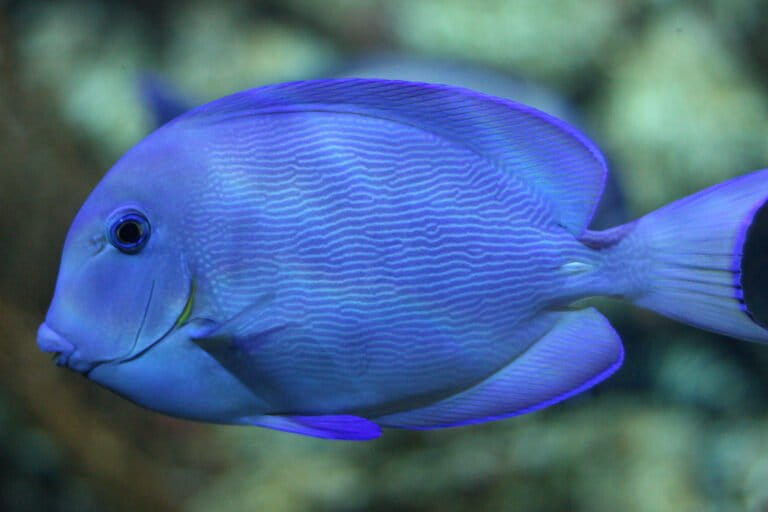
Header image: Atlantic blue tang surgeonfish (Acanthurus coeruleus). Photo by Sylfred1977 / Wikimedia Commons
Citation:
Dantzker, M. S., Duggan, M. T., Berlik, E., Delikaris-Manias, S., Bountourakis, V., Pulkki, V., & Rice, A. N. (2025). Deciphering complex coral reef soundscapes with spatial audio and 360° video. Methods in Ecology and Evolution, 16(11). https://doi.org/10.1111/2041-210X.70149
Kaia Glickman is a graduate student in the Science Communication M.S. Program at the University of California, Santa Cruz. Other HAWXTECH.NET stories produced by UCSC students can be found here.

Posting Komentar untuk "Underwater Acoustic Camera Identifies Fish Sounds to Track Endangered Species"
Posting Komentar